

Happy Friday Team!
Let me hit you with a number: $1.1 trillion.
That’s China’s trade surplus for 2025. A record. The highest ever recorded.
And here’s the kicker—this happened despite Trump’s tariff war. Despite Section 301. Despite “Liberation Day.” Despite collecting $250.9 billion in tariff revenue.
So what the hell is going on?
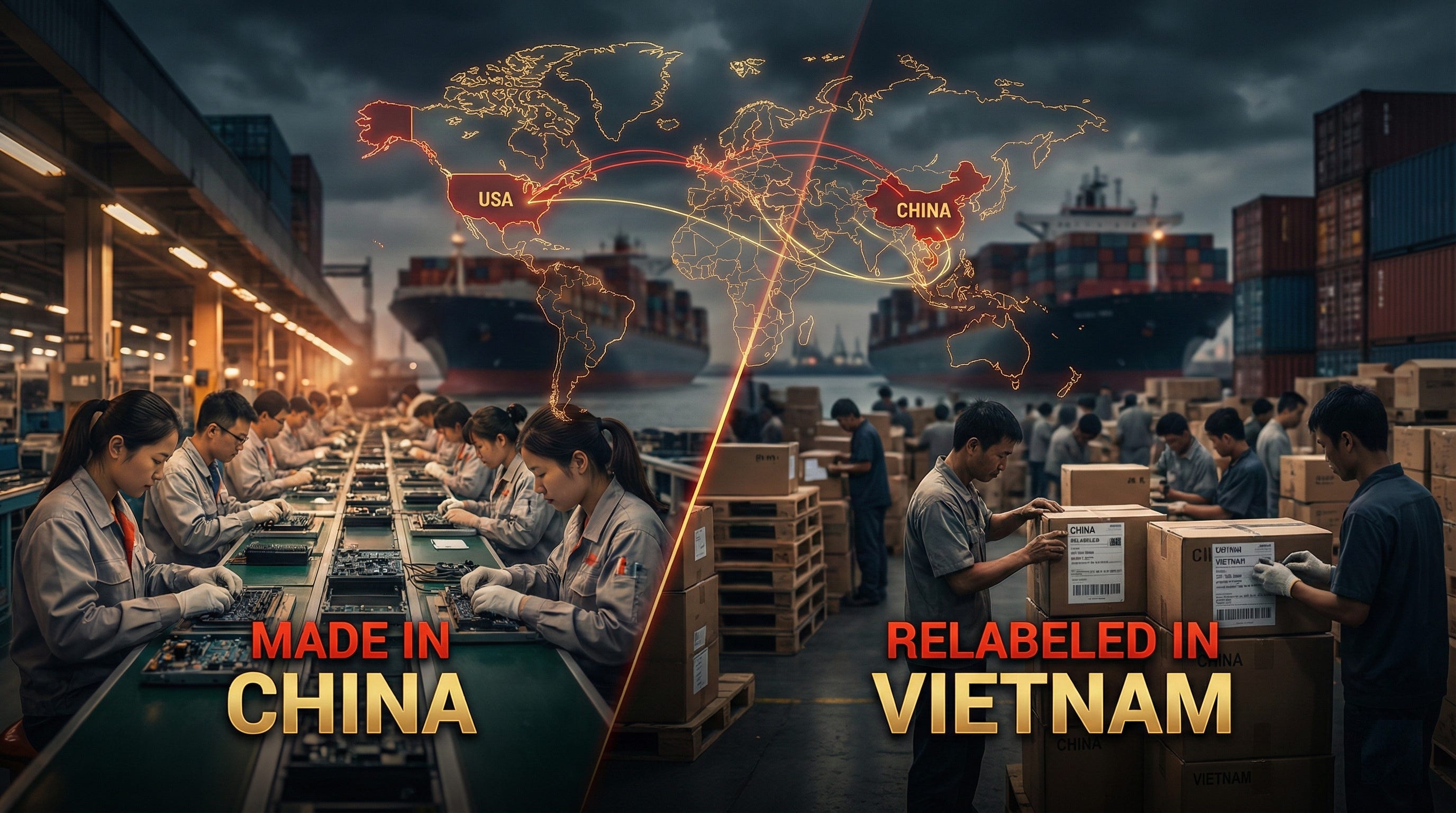
The Shadow Factory Playbook
China figured out the game. And they’re playing it perfectly.
According to supply chain data from Exiger (they work with the Pentagon and Customs), Chinese companies aren’t eating the tariffs. They’re routing around them.
Here’s how it works:
1. Build products in China
2. Ship components to Vietnam, Thailand, or Indonesia
3. Do minimal “assembly” in a shadow factory
4. Ship to the US as a “Vietnamese” product
5. Pay lower tariffs. Pocket the difference.
The Numbers Tell the Story
Let’s look at the US Census Bureau data. This is where it gets interesting.
US-China Trade Deficit:
• 2018 (pre-tariffs): $418.2 billion
• 2019 (tariffs begin): $342.6 billion
• 2020 (COVID): $308.0 billion
• 2022 (post-COVID): $382.3 billion
• 2024: $295.5 billion
• 2025 (through November): $189.4 billion
On the surface, this looks like a win. The deficit with China dropped from $418 billion to $189 billion. That’s a $229 billion reduction!
But here’s the part nobody’s talking about.
US-Vietnam Trade Deficit:
• 2018: ~$40 billion
• 2020: $69.7 billion
• 2022: $116.1 billion
• 2024: $123.5 billion
• 2025 (through November): $161.2 billion
That’s a 4x increase since 2018. Vietnam went from a $40 billion deficit to being on pace for $175+ billion in 2025.
The math is simple: the goods are still coming. They’re just coming through a different door.
80% of shipments from Chinese-owned companies to the US now route through Vietnam. Imports from Vietnam, Thailand, and Indonesia are each up 20% year-over-year. China creates the product, ships components to a “shadow factory” in Southeast Asia, does minimal assembly, and exports it as Vietnamese or Thai goods.
It’s the same product. Lower tariffs. Brilliant strategy.
The Trade Deficit Just Got Worse
While the China-specific numbers look better on paper, the overall US trade picture is deteriorating fast.
November 2025 numbers just came in:
• Total US trade deficit: $56.8 billion (nearly doubled from October’s $29.2 billion)
• Deficit with Vietnam: $16.2 billion (up from $15.0 billion)
• Deficit with EU: $14.5 billion (more than doubled from $6.3 billion)
• Deficit with China: $14.7 billion (up from $13.7 billion)
Year-over-year, the total US trade deficit is up 4%. The record low was -$136.42 billion in March 2025.
We’re collecting tariffs. We’re not fixing the trade imbalance.
The Human Cost
Beyond the numbers, there’s a darker element to this story.
According to Exiger’s forced labor database (forcedlabor.ai), China’s supply chain expansion relies heavily on illicit labor practices. The International Labour Organization estimates 28 million people are subjected to forced labor worldwide—63% in the private economy, generating $236 billion in illegal profits annually.
Chinese companies are using forced labor to produce goods cheaply in China, then shipping them to secondary markets for final assembly. It’s how they’re subsidizing the tariff workaround costs.
The US added 78 new entities to the forced labor list in 2025, bringing the total to 144 Chinese entities. But enforcement is incredibly difficult when products route through Vietnam, Thailand, and Malaysia before reaching US ports.
What This Means for Markets
Here’s where it matters for us as traders:
1. Dollar Pressure: If tariffs aren’t shrinking the trade deficit, the fundamental case for dollar strength weakens. More deficit = more dollars flowing overseas = long-term bearish pressure.
2. Inflation Isn’t Going Away: Companies are eating tariff costs OR passing them to consumers. Either way, margins get squeezed and prices stay elevated.
3. Gold Tailwind: Geopolitical uncertainty + dollar weakness + inflation concerns = the perfect storm for precious metals. Gold at $5,600 isn’t the top.
4. Equity Volatility: Every time Trump escalates (and he will), markets react. The trade war is far from over—it’s evolving. That means more headline risk, more gap-and-go mornings, more opportunity if you’re prepared.
The Bottom Line
China isn’t losing the trade war. They’re adapting faster than policy can keep up.
We reduced our deficit with China by $229 billion since 2018. In the same period, our deficit with Vietnam increased by $135 billion. Add Thailand, Indonesia, and Malaysia—the goods are still flowing, just through different channels.
$250 billion in tariff revenue sounds impressive until you realize China’s global surplus hit $1.1 trillion anyway. The shadow factory network is real, it’s growing, and it’s changing global supply chains in ways that will take years to unwind.
For traders, this is context. It’s the macro backdrop behind every FOMC decision, every inflation print, every headline that sends ES ripping or dumping 30 handles in 10 minutes.
Know the game. Trade the levels. Let the data guide you.
Until next time—trade smart, stay prepared, and together we will conquer these markets.
Ryan Bailey
VICI Trading Solutions