

Hello Team,
Something fundamental just shifted in how the Federal Reserve is approaching this market — and if you’re not paying attention, you’re going to get caught on the wrong side of it.
For the last 18 months, the playbook was simple: inflation is cooling, rate cuts are coming, risk assets go up. Wall Street entered 2026 expecting more of the same. Easy money. Smooth ride.
Not Anymore.
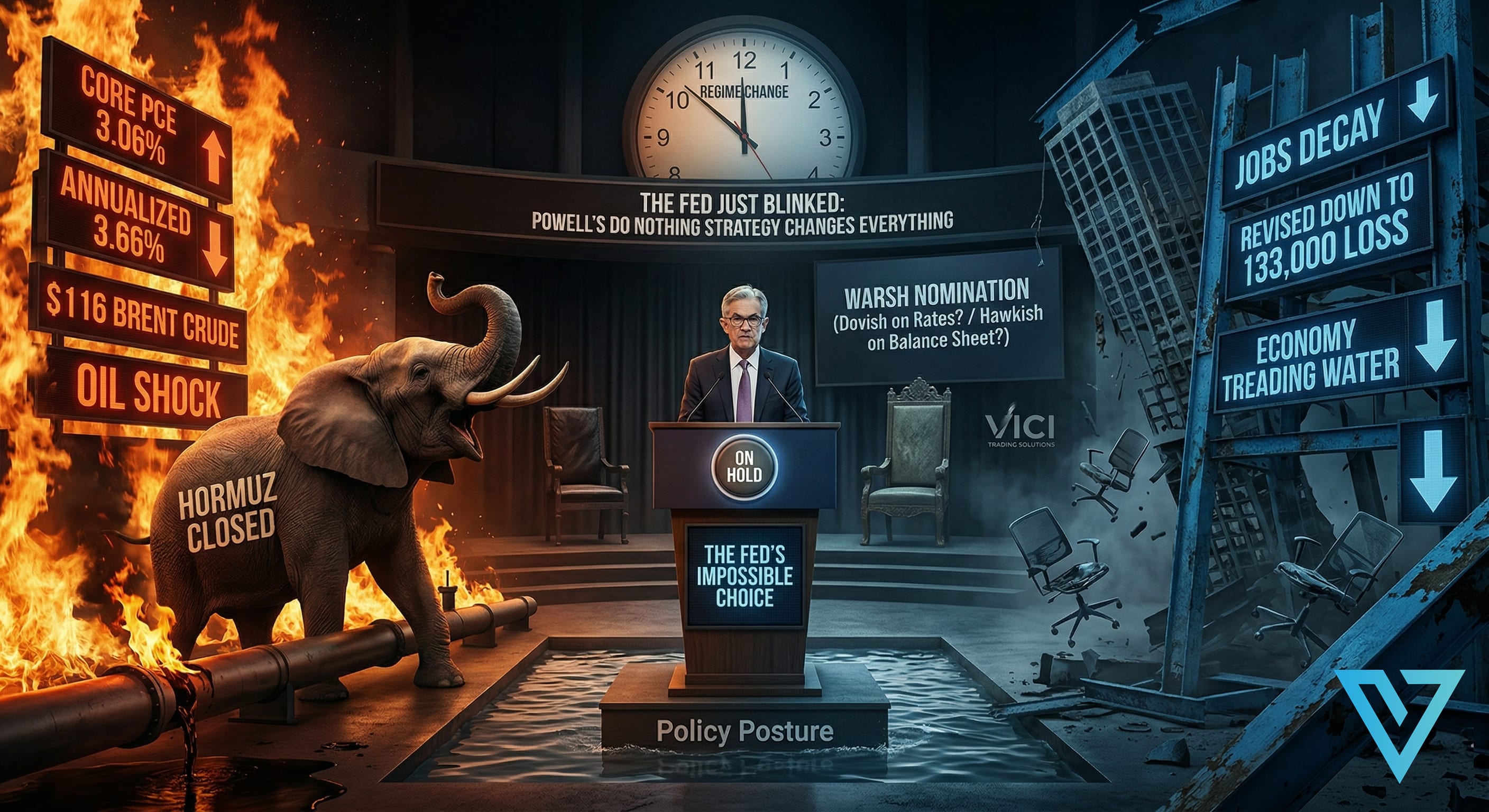
On March 30th, Fed Chairman Jerome Powell stepped up to a podium at Harvard University — a guest lecture in an introductory macroeconomics class, of all things — and essentially told the world: we can’t fix both problems, so we’re going to fix neither.
That might sound like “no news.” It’s actually the biggest shift in Fed policy posture since the rate-cutting cycle began in September 2024.
And the timing couldn’t be more consequential. We’re five weeks into the largest oil supply disruption in modern history. Yesterday’s jobs report just blew past expectations. And in six weeks, someone entirely new will be sitting in Powell’s chair.
Let me break down exactly what all of this means — and how I’m thinking about it.
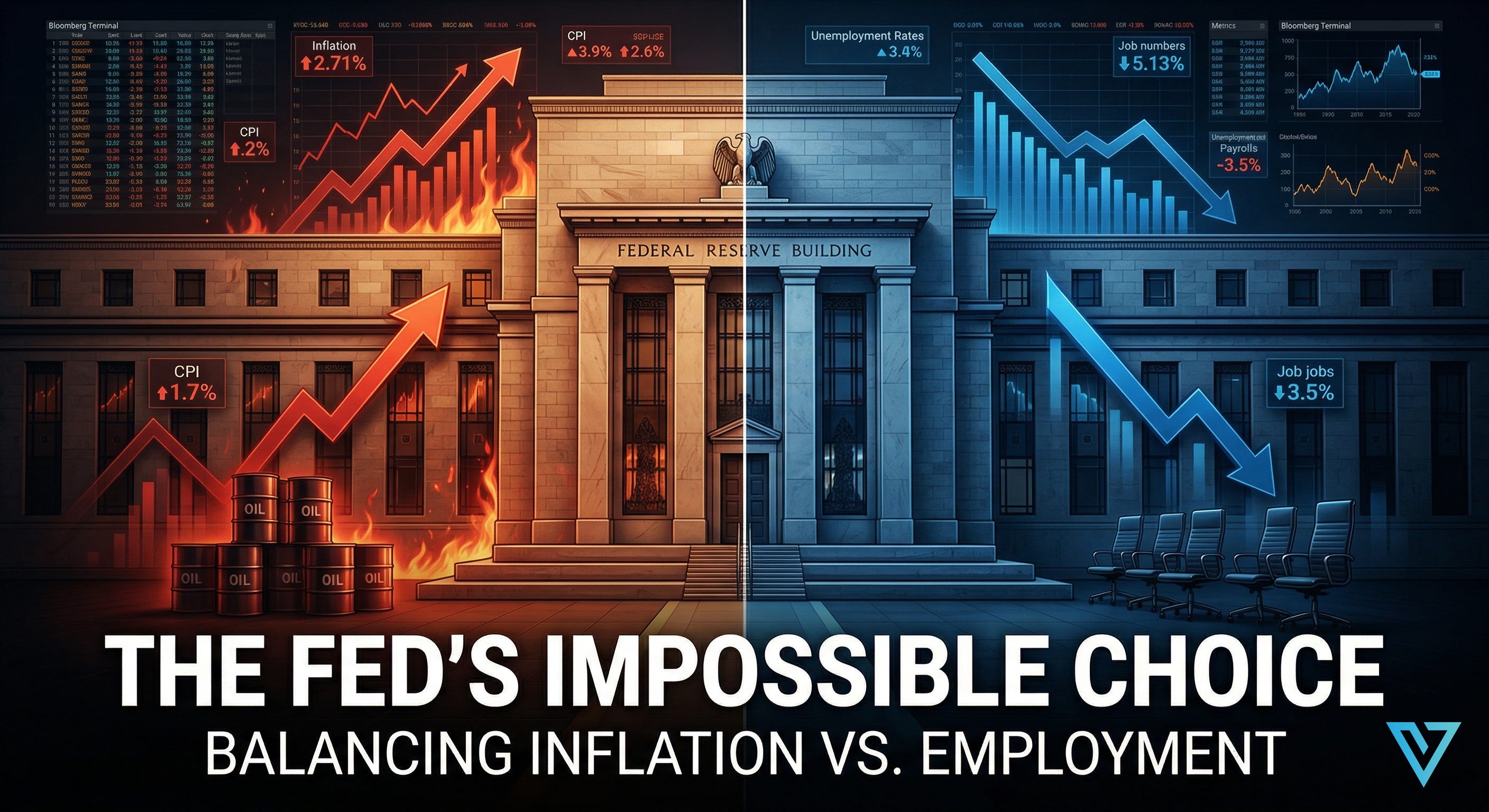
The Fed’s Impossible Choice
The Federal Reserve has two jobs. Keep inflation near 2%. Keep the job market healthy. For most of the last two years, those goals were pointing in the same direction — inflation was falling, jobs were holding up, and rate cuts made sense on both fronts.
That alignment just broke.
Inflation is accelerating again. Core PCE — the Fed’s preferred inflation gauge — has climbed to 3.06% year-over-year as of the latest January reading. The three-month annualized rate is running even hotter at 3.66%. That’s not just above the 2% target — it’s moving in the wrong direction. The FOMC itself revised its 2026 core PCE projection up to 2.7% in March — the largest single-year upward revision in recent cycles. And with oil above $110 a barrel, gas approaching $4 a gallon nationally, and the Strait of Hormuz still effectively closed, those numbers are almost certainly heading higher in the months ahead.
In a normal environment, the Fed would be raising rates right now. Full stop.
But the job market has been deteriorating. The economy lost 133,000 jobs in February — revised down from the originally reported 92,000 loss. That revision is significant: it means the labor market was even weaker than it looked in real time. Employers averaged fewer than 10,000 new jobs per month through all of 2025 — the weakest hiring outside a recession since 2002. And Powell himself said at the March FOMC press conference that the private sector has created zero net jobs over the last six months once you adjust for data collection disruptions during government shutdowns.
In a normal environment, the Fed would be cutting rates aggressively. Full stop.
Now, yesterday’s March jobs report threw a curveball. The headline: 178,000 jobs added versus expectations of roughly 60,000. On the surface, that looks like a strong bounce. But experienced traders know to look under the hood.
Of those 178,000 jobs, 76,000 came from healthcare alone — driven overwhelmingly by Kaiser Permanente workers returning from a strike that had suppressed February’s numbers. That single event accounts for 43% of the entire headline gain. Strip it out, and you’re looking at a far more modest picture. Wage growth also cooled to 3.5% year-over-year — the lowest since May 2021. And the four-month rolling average (December through March) works out to roughly 47,000 jobs per month. That’s not a robust labor market. That’s an economy treading water.
Following yesterday’s report, futures markets are now pricing in a 77.5% probability the Fed stays on hold through the end of the year. Not cutting. Not hiking. Frozen.
The problem remains the same: you can’t do both. Raise rates to fight inflation and you crush an already-fragile labor market. Cut rates to save jobs and you pour gasoline on a 3%+ inflation fire that’s being fed by the biggest energy shock in decades.
So Powell chose door number three: do nothing.
What Powell Actually Said (And What He Meant)
At Harvard, Powell used a specific phrase that market veterans know well. He said the Fed will try to “look through” the oil-driven inflation spike.
Translation: We think this is temporary, and we’re not going to overreact.
Here’s the logic — interest rate changes take months to fully work through the economy. If the Fed hiked rates today to fight oil-driven inflation, the impact wouldn’t be felt until late 2026 or early 2027. By then, the Middle East situation could be resolved and oil could be back to normal levels. In Powell’s own words: “By the time the effects of a tightening in monetary policy take effect, the oil price shock is probably long gone, and you’re weighing on the economy at a time when it’s not appropriate.”
He then stated that the Fed feels its current policy — the federal funds rate at 3.50%–3.75% — is in a “good place” to wait and observe how events unfold. That’s Fed-speak for: rates aren’t moving in either direction.
But here’s the caveat that most people glossed over. Powell also said something that should keep every trader on alert: “You have to carefully monitor inflation expectations because you could have a series of big supply shocks and that can lead the public generally, businesses, price setters, households… to start expecting higher inflation over time. Why wouldn’t they?”
He specifically referenced the 1970s — when repeated oil shocks unanchored inflation expectations and forced the Fed into years of aggressive tightening that crushed the economy. Powell added: “We worry a lot about that.”
This is the Fed telling you: we’re standing still for now. But if inflation expectations start slipping, all bets are off.
For traders, that clarity matters more than the direction. Before Powell spoke, the futures market was pricing in a better than 50% chance of a rate hike by December. Within hours of his Harvard appearance, that probability collapsed to just 2.2%. One speech removed the worst-case scenario from the table.
The Oil Shock Is Bigger Than Most Traders Realize
Let’s talk about the elephant blocking the Strait of Hormuz.
The Iran conflict, now in its fifth week, has produced what the head of the International Energy Agency called “the greatest global energy security challenge in history.” That’s not hyperbole. Consider the math:
Roughly 20% of global oil supply normally transits the Strait of Hormuz. Since Iran effectively shut down the waterway in early March, the world has lost an estimated 12 million barrels per day of supply — more than double the losses during the 1973 and 1979 oil crises combined. Brent crude has surged from the low $80s to above $116 a barrel at its recent peak. WTI topped $110 this week after Trump’s national address vowed to strike Iran “extremely hard.”
The U.S. and other IEA member nations have released 400 million barrels from strategic petroleum reserves — the largest coordinated release in history. Washington has temporarily lifted sanctions on some Russian and Iranian oil to give the market breathing room. But these are Band-Aid measures on a structural wound.
As the IEA’s Fatih Birol warned this week: “This is only helping to reduce the pain, it will not be a cure. The cure is opening up the Strait of Hormuz.” He added that April will be significantly worse than March — the cargo ships that were already in transit when the strait closed have reached their destinations. From here, the supply gap widens. Analysts at BCA Research estimate the barrels lost will roughly double by mid-April, becoming “the largest loss of crude supply” in history.
This is the macro variable that dominates everything else right now. Oil is an input cost for virtually every product that moves by land, sea, or air. When oil stays elevated, it feeds into transportation costs, food prices, manufacturing costs, and ultimately corporate margins. The earnings tailwind that supported the market in 2025 could become a headwind very quickly if energy costs remain at these levels through Q2.
The White House has signaled a four-to-six-week timeline for the conflict. We’re now in week five. President Trump said Wednesday that the U.S. is “getting very close” to ending the war — but also warned it could continue for weeks. Iran, for its part, has flatly rejected Trump’s terms and proposed its own ceasefire conditions, including war reparations.
This is the kind of headline-driven, gap-and-go volatility that separates traders who are prepared from traders who are scrambling. You cannot afford to be reactive in this environment. The news will move faster than your ability to process it — which is why having defined levels, clear risk parameters, and a structured daily plan is not optional right now. It’s survival.
The Wild Card: A Regime Change Inside a Regime Change
Here’s where it gets really interesting — and where I think the market is significantly underpricing risk.
Jerome Powell’s term as Fed Chair officially ends on May 15th.
President Trump has nominated Kevin Warsh — a former Fed governor under George W. Bush and former Morgan Stanley investment banker — to replace him. The Senate Banking Committee is reportedly planning a confirmation hearing as soon as the week of April 13. If confirmed, Warsh would begin his four-year term immediately after Powell steps down.
Here’s what most of the surface-level coverage gets wrong: Warsh is not simply a “hawk” or a “dove.” He’s something more complicated — and potentially more disruptive.
On interest rates, Warsh has actually signaled he favors lower rates than the current level. He’s argued that productivity gains from AI and other technologies should allow the economy to grow faster without generating inflation, creating room for rate reductions. Multiple analysts — Invesco, Edward Jones, and others — have described his nomination as a likely dovish shift on rates relative to Powell.
But on the Fed’s balance sheet, Warsh is genuinely hawkish. He’s been a vocal critic of the Fed’s bond holdings, arguing they expanded excessively through multiple rounds of quantitative easing. His proposed approach: cut rates to stimulate growth while simultaneously shrinking the balance sheet to offset the inflationary risk. It’s an unconventional combination, and the market hasn’t fully digested what it would mean in practice.
And then there’s the confirmation uncertainty. Senator Thom Tillis of North Carolina — a Republican on the Banking Committee — has vowed to block any Fed nominee until the Department of Justice drops a criminal investigation into Powell over his testimony about Fed building renovations. The Banking Committee has a narrow 13-11 Republican majority. If Tillis follows through and all Democrats vote no, Warsh’s nomination stalls in committee. In that scenario, Vice Chair Philip Jefferson would serve as acting chair — and the policy status quo continues under autopilot.
So here’s the scenario that should be on every trader’s radar:
Now through May 15: Powell holds rates steady. Markets get the “no surprises” stability they’re craving.
After May 15 (if Warsh is confirmed): A potentially more dovish Fed chair takes over — but one with a radically different philosophy on the balance sheet. The market may start repricing rate cut expectations almost immediately, which could be supportive for equities. But any balance sheet tightening signals could whipsaw bonds.
If confirmation stalls: Jefferson holds the chair on an acting basis. The “higher for longer” holding pattern continues. No catalyst in either direction.
That’s a regime change within the regime change. The market is pricing in Powell’s “do nothing” stance. It is NOT fully pricing in what comes next.

Putting It All Together: The Roadmap
So where does all of this leave us? Here’s how I’m framing it:
Short-term (next 2–4 weeks): Powell removed the rate hike scare, which puts a floor under the market. But surging oil, Hormuz uncertainty, and headline-driven volatility cap the upside. The S&P is roughly 5–7% off its January all-time high. I expect it to remain range-bound until we get resolution on the conflict or a meaningful break in oil prices. This is a trade the levels environment — not a pick a direction and lean environment. Don’t get caught swinging for the fences when the market is chopping.
Medium-term (May–June): The Warsh confirmation becomes the next major catalyst. Watch the Banking Committee hearing (potentially week of April 13), the committee vote, and the full Senate vote — each is a potential inflection point. The April CPI report on April 10 is the next critical data print. If energy costs are already feeding into core measures, the “look through” narrative gets harder to sustain.
Longer-term (Q3–Q4): If the Iran conflict resolves and the Strait of Hormuz reopens, oil prices should normalize relatively quickly, and I’d expect the market to shift its focus back to the rate cut narrative — particularly under a Warsh-led Fed. That would be the setup for a meaningful move higher in the S&P into the second half of the year. But if the conflict drags on and energy prices remain elevated through summer, the stagflation conversation gets very real, and that’s a much more challenging environment for equities.
The Bottom Line
The Fed just told you exactly what it’s going to do: nothing. And in this environment, that’s actually the best-case scenario.
Powell is choosing stability over action, betting that the oil shock is temporary and the job market needs room to breathe. For the next six weeks, that means:
No rate hikes (the worst case is off the table)
No rate cuts (the job market is on its own)
A narrow window of policy certainty before the Warsh wildcard reshuffles the deck
The smart play right now isn’t to predict where rates go next. It’s to trade what’s in front of you — and what’s in front of you is a Fed that just removed the tail risk from the table, a market that’s range-bound between oil fear and rate relief, and a six-week countdown to a leadership transition that could change everything.
Use the clarity while it lasts. Because after May 15th, all of this could change.
Until next time—trade smart, stay prepared, and together we will conquer these markets!
Ryan Bailey, VICI Trading Solutions.