


This Is The Line Nobody Can “Spin”:
Let me simplify this down to one sentence:
If your debt grows at a faster rate than your economy, the market eventually demands a higher price to fund you.
That “price” is yield.
And once yields become the story, they don’t just sit in the bond market. They bleed into:
equity valuations
mortgage rates
corporate refinancing
credit spreads
and (most importantly) liquidity
You can run a big debt load for a long time.
But you can’t outrun the math forever.
The Receipts ~ (CBO Baseline + What It Implies)
According to the latest Congressional Budget Office projections:
Publicly held debt: ~$31T today (about 100% of GDP)
2030: projected to exceed the prior post‑WWII record of 106% of GDP
2036: projected around 120% of GDP
Now here’s the part that matters to markets:
Annual net interest is projected to more than double to about $2.1T by 2036.
That number is not just “a lot.”
It’s a structural claim on future cash flows.
It crowds out everything else.
And importantly:
Nominal GDP growth is expected to cool to roughly 3.8% by 2027.
Treasury’s average interest rate is about 3.316% today.
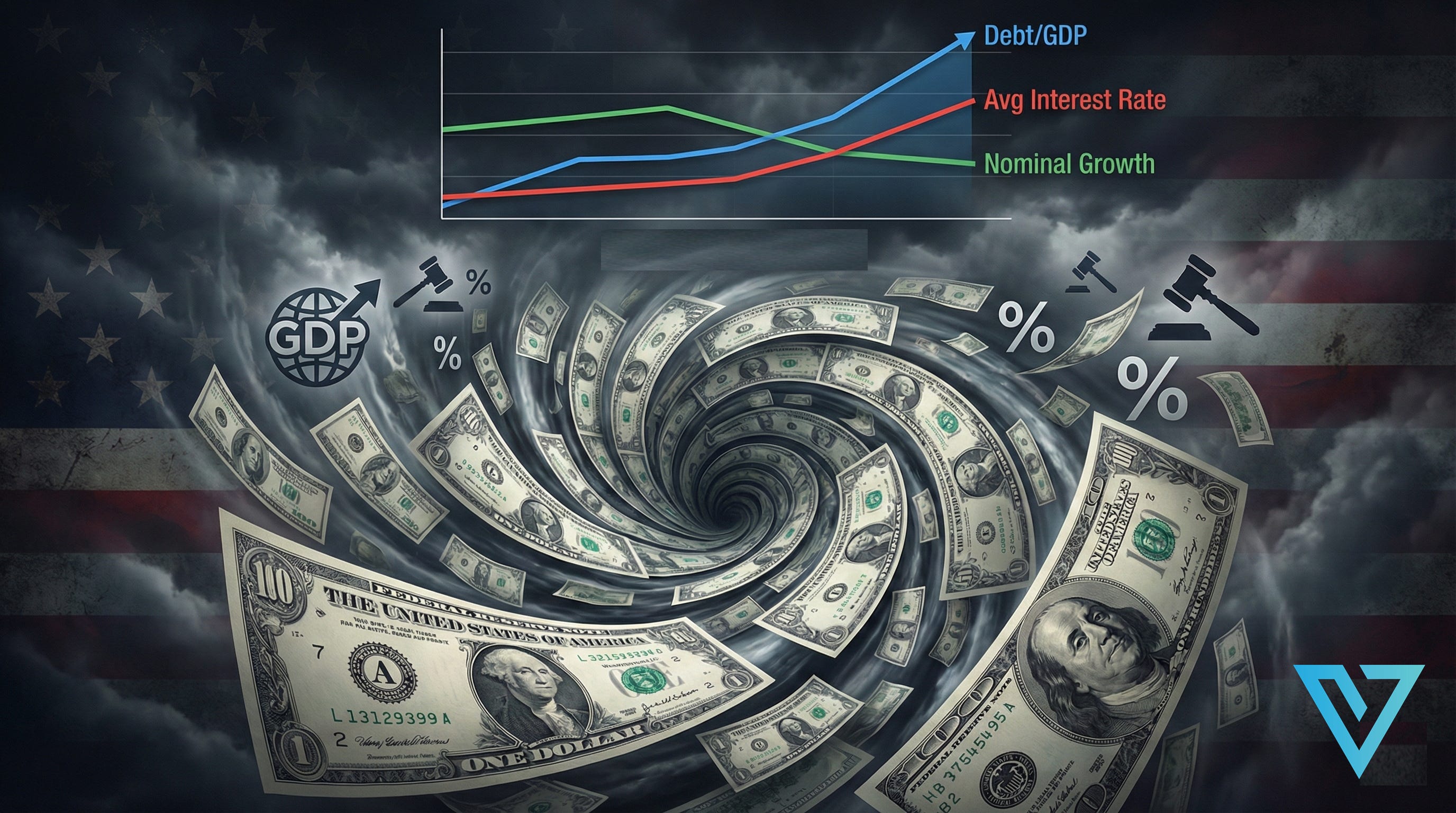
If average funding costs keep drifting up while nominal growth drifts down, you eventually hit the crossover:
Average interest rate > nominal GDP growth
That’s the tripwire.
CRFB put it bluntly: that crossover “could represent the start of a debt spiral.”

What A “Debt Spiral” Really Means
(In Plain English)
People hear “debt spiral” and picture immediate collapse.
That’s not how it usually works.
It’s more like this:
Higher debt → more issuance
More issuance → investors demand higher yield (term premium)
Higher yield → higher interest expense
Higher interest expense → bigger deficits
Bigger deficits → even more issuance
Now add the “confidence” piece:
If markets start believing policymakers won’t (or can’t) make adjustments,
they price that risk into the long end.
That’s when the long bond starts acting like a pressure gauge for the entire system.
Why Traders Should Care:
(Even If You Never Touch Bonds)
This matters because rate shocks are the fastest way to flip the regime.
When the long end is calm, equities can float.
When the long end starts ripping higher, equities start doing math again.
A few practical translations:
Higher long-end yields compress P/E multiples.
Higher refinancing costs hit small caps and junk hardest.
Higher mortgage rates tighten financial conditions.
Higher term premium increases index volatility.
And in S&P 500 terms:
You don’t need a recession for drawdowns.
You just need yields to be “wrong” relative to positioning.
What This Means For Everyone Else
(Not Just Traders):
When the government’s interest bill grows faster than the economy, more of the budget gets eaten by “debt service” instead of things that actually improve life. Over time that usually shows up as some mix of:
1. Higher borrowing costs that hit households directly (mortgages, car loans, credit cards),
2. Weaker growth that shows up indirectly (slower hiring, softer wage momentum, fewer good opportunities), and
3. Tougher tradeoffs in Washington (higher taxes, reduced services, or both).
The other problem is it handcuffs the next downturn—because when we need support, a bigger slice of any new spending just goes to interest instead of relief or investment.
Dont Expect a sudden blow-up, it will be more like a slow squeeze that makes everyday costs and job conditions more sensitive to rate moves.
What I’m Watching:
(The Trader’s Dashboard)
You don’t trade the headline. You trade the signal.
Here’s the signal set I care about:
Treasury auction quality
weak bid-to-cover
higher tail
indirect bidder participation falling
2. Term premium + long-end persistence
it’s one thing for yields to spike
it’s another thing for them to stay elevated
Credit spreads
if spreads start widening while equities pretend nothing’s wrong, that’s a warning
Dollar + Risk-Parity Behavior
a rising dollar alongside rising yields can tighten liquidity quickly
Volatility response
when VIX/vol expands on “rate up” days, the market is telling you the regime is shifting
What This Means for Traders: (Actionable, Not Theoretical)
If we’re drifting toward an interest > growth world, here’s the clean takeaway:
Expect faster, meaner rotations. Rate sensitivity becomes the hidden driver.
Don’t ignore the long end. Even if your whole world is ES/SPX, the long bond can become the trigger.
Respect liquidity windows. When auctions/Fed/major data cluster, treat those sessions like “event risk.”
Trade the structure. In these regimes, the market punishes sloppy entries and rewards patience at levels.
I’m not saying “sell everything.”
I’m saying: if yields start behaving like they’re in charge, trade like they’re in charge.
Bottom Line:
Big debt is a slow story. “Interest > growth” is a fast story.
And the moment markets start pricing that crossover as inevitable, you’ll feel it in:
the long end
credit
and eventually… equities.
Until next time—trade smart, stay prepared, and together we will conquer these markets.
Ryan Bailey
VICI Trading Solutions