


Hello Team,
Most traders think their biggest enemy is volatility.
It isn’t.
Your biggest enemy is comparison.
Not chart patterns. Not news headlines. Not a bad fill.
Comparison.
The moment your trading day becomes “How am I doing versus everyone else?” instead of “Am I executing my process?”, you leave your own edge and enter someone else’s game.
And in markets, that gets expensive fast.
The Hidden Trap: Trading Becomes a Social Ranking Game
If we’re honest, most traders aren’t only trading price action.
They’re trading:
Another trader’s P&L screenshot.
Someone’s callout in a Discord room.
A loud X post about a “10R day.”
The fear that they’re somehow falling behind.
That creates a dangerous, toxic mental state:
You force trades to “catch up.”
You size too big after seeing someone else’s massive win.
You abandon your tested plan because your pace feels too slow.
Now you’re not executing strategy. You’re emotionally reacting to a scoreboard you don’t control.
No trader performs well from that state.
The Real Game: Compete With Your Last 20 Sessions
The highest-level shift in trader psychology is simple:
Stop competing with other traders. Start competing with your own process quality.
Markets don’t pay you for looking impressive on social media. They pay you for repeating high-quality decisions under uncertainty.
That means your true scoreboard is internal:
Did you follow your setup rules?
Did you manage risk exactly as planned?
Did you avoid revenge entries?
Did you stay aligned with your timeframe and conditions?
Did you journal what mattered, not just the financial outcomes?
This is less exciting than social comparison. It is also how real consistency is built.
Why Comparison Wrecks Performance (Even for Talented Traders)
Comparison feels productive because it creates a false sense of urgency. But urgency without alignment creates damage.
1) Comparison Destroys Attention
When your mind is on someone else’s outcome, it isn’t on your own execution. Your read quality drops. Your timing gets worse. Your risk discipline slips.
2) Comparison Creates Emotional Overtrading
If your self-worth is tied to a daily rank, flat days feel like failure. You start manufacturing action just to feel “in the game.”
3) Comparison Inflates Size at the Wrong Time
You see someone else’s home run and unconsciously increase risk before your own setup quality justifies it. That’s how one red day erases a week of progress.
4) Comparison Makes You Abandon Your Season
Some traders are in a refinement season. Others are in a scale season. If you confuse the two, you rush growth and sabotage both. You can’t force harvest in spring. Trading psychology follows the exact same law.
A Better Lens: Process Peace > Outcome Noise
Here is the paradox:
The trader who chases outcomes usually gets more noise. The trader who chases process quality usually gets better outcomes.
Why? Because process gives you control. And control lowers emotional volatility.
When your mind is calmer:
Your entries are cleaner.
Your exits are less reactive.
Your sizing is more rational.
Your post-trade reviews are more honest.
That is how confidence is built: not by “beating” someone else today, but by keeping promises to yourself repeatedly.

The Trader’s Internal Competition Framework (Use This Daily)
If you want practical psychology, run this framework for your next 30 sessions.
1) Define Your Non-Negotiables (Max 5)
Example:
Only take A+ setups from my playbook.
Hard stop always in before entry.
No adding to losers.
No revenge trade within 20 minutes of a loss.
End session immediately if I break 2 rules.
If your rules are vague, your discipline will be vague.
2) Score Execution, Not P&L
After each session, score yourself from 1–10 on:
Setup quality adherence
Risk discipline
Emotional control
Journal quality
Track this over 20 sessions. That trend matters significantly more than a single green day.
3) Separate the “Good Loss” from the “Bad Loss”
A good loss followed your process. A bad loss violated your plan.
Most traders emotionally label both as failure. That confusion keeps them stuck.
4) Run Weekly Debriefs With One Question
“What behavior cost me the most this week?”
Not “What ticker hurt me?” Not “What news event hurt me?”
Behavior first. Then correction.
5) Scale Only When Process Metrics Improve
Don’t scale because you feel good. Scale because your execution trend proves you’re ready. If your process score is unstable, your size should be stable.
Apply This to Real Trading Decisions
Let’s make this concrete so you can use it tomorrow.
Scenario A: You see another trader post a massive winner
Old pattern: FOMO spikes → You chase a late setup → Oversized entry → Emotional stop-out.
New pattern: Pause → Ask: “Does this match my system and conditions?” → If no, pass without guilt → Log the pass as discipline.
(A passed bad trade is a profitable decision).
Scenario B: You start the day with two small losses
Old pattern: Need to “get it back now” → Third trade is forced → Day compounds negatively.
New pattern: Re-center on rules → Reduce size or stop for session if criteria hit → Protect emotional capital first.
(Survival days are professional days).
Scenario C: You’re flat while others are celebrating
Old pattern: Feel behind → Force low-quality setups late session.
New pattern: Rate session quality → If quality is high, accept flat as valid → Keep powder dry for better conditions.
(Flat with discipline beats green with chaos).
The Psychology Edge Most Traders Miss
Most traders think psychology means motivation.
It doesn’t.
In trading, psychology is structure for your mind:
Clear rules.
Clear accountability.
Clear review loops.
Clear boundaries when you’re off the desk.
Motivation is loud and temporary. Structure is quiet and compounding.
That’s why disciplined traders seem “calm” under pressure. They aren’t magically fearless. They just eliminated unnecessary internal conflict.
Your 7-Day Mental Reset Plan
If your head has been noisy lately, run this protocol for one week:
Day 1: Remove external scoreboards. Mute P&L content that triggers urgency. Limit pre-market social consumption.
Day 2: Rewrite your playbook on one page. Define your entry conditions, risk limits, invalidation criteria, and session stop rules.
Day 3: Add a pre-trade checklist. Is the setup valid? Is risk defined? Is this an emotional or strategic click?
Day 4: Grade 5 trades on execution only. Ignore the financial result entirely. Grade your decision quality.
Day 5: Identify your top emotional leak. Is it FOMO? Revenge? Hesitation? Oversizing? Pick one and design a strict constraint against it.
Day 6: Simulate your stress response. Before the open, write down: “If I start red, I will ___.” Pre-commitment prevents emotional improvisation.
Day 7: Weekly review + one process upgrade. Choose one behavior to remove completely and one behavior to reinforce next week.
Do this for 4 weeks and your equity curve may not just improve—your entire relationship with trading will improve.
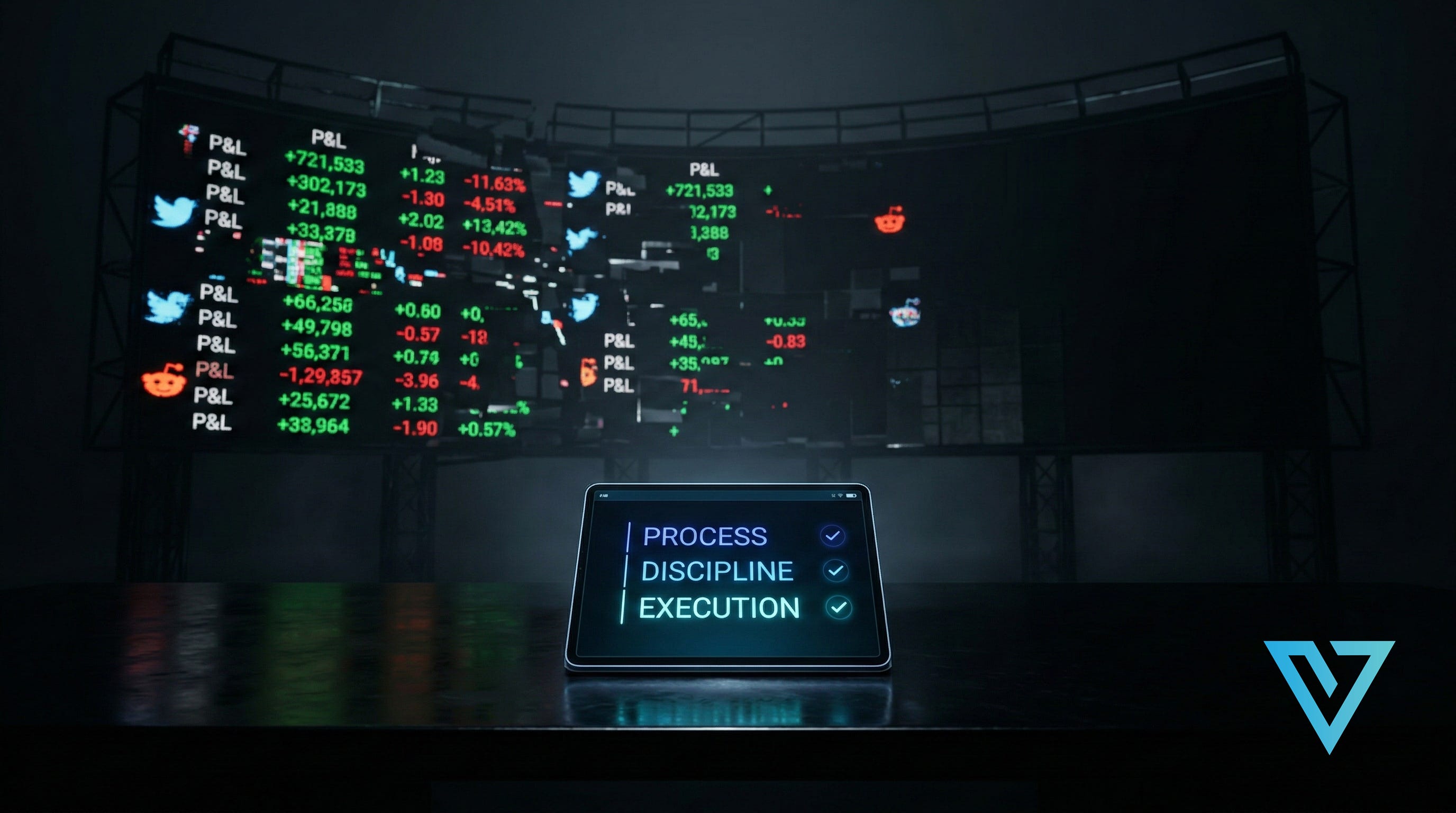
Final Thought: Stop Racing Traders Who Aren’t Running Your System
You don’t have their account size.
You don’t have their risk tolerance.
You don’t have their constraints, psychology, or season.
So don’t borrow their pace. Build your own.
The market is not asking you to outperform everyone in public. It’s asking you to execute your edge in private, repeatedly, with absolute discipline.
That is the game. And it’s the only one that compounds.
If this helped, send it to a trader who’s talented but distracted. Sometimes one psychology shift saves months of unnecessary drawdown.
Until next time—trade smart, stay prepared, and together we will conquer these markets!
Ryan Bailey
VICI Trading Solutions