

There are no trade plans this week.
Not a reduced schedule. Not a lighter version. None.
I’m pausing every paid subscription on S&P Edge from today, Sunday, September 13, through Friday, September 18. Nobody gets charged for the week. If you’re on the annual plan, a week gets added to the end of your term — you don’t lose a day of what you paid for.
I want to walk you through exactly why, because the reasoning is worth more to you than the announcement is.
Four times a year, the market hands us a legitimate reason to stand down. This is one of them.
I’ve been trading for twenty years, ten of them in ES specifically. I don’t take weeks off because I’m tired. I take them when the instrument stops behaving like the instrument my process was built around.
That’s rollover.
Rollover Isn’t a Symbol Change
Most traders treat the roll as housekeeping. Update the chart, change the contract month in the order ticket, get on with the day.
That’s the surface of it.
What’s actually happening underneath is that the entire liquidity base of the S&P 500 futures market picks itself up and moves from one contract to another — and for a stretch of days, it lives in both places at once.
Here’s the schedule, and I want you to see the dates, because “rollover week” gets thrown around loosely and the specifics are what make the case.
CME’s own convention sets the equity index roll date as the Monday prior to the third Friday of the expiration month. For September 2026, that’s tomorrow — Monday, September 14. After that date, the customary practice is to treat the second-nearest expiration as the lead month, precisely because the expiring contract is walking into a thinner market.
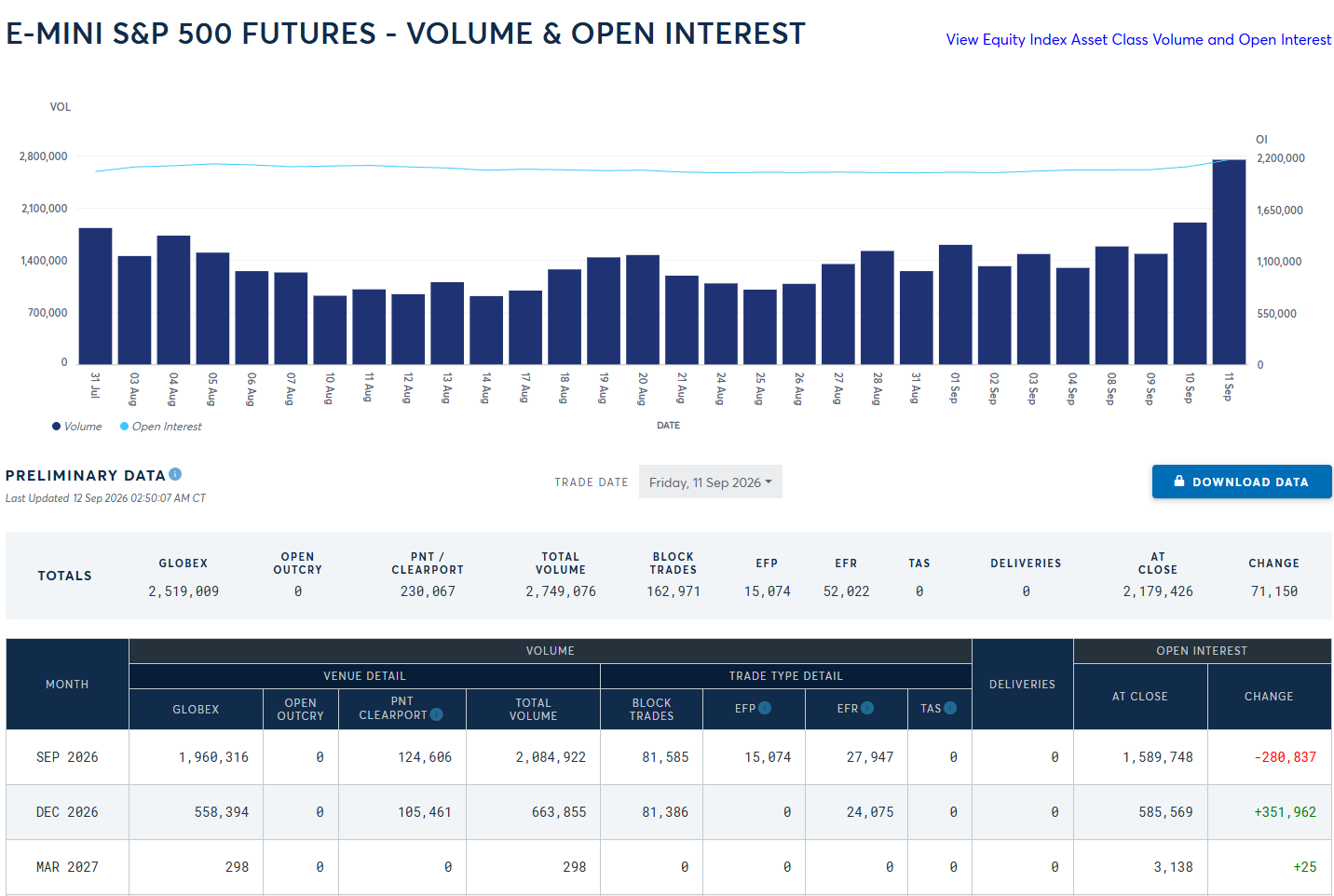
But the street doesn’t wait on the exchange. The working convention on most desks is roughly eight days ahead of expiration, which pulled real size into ESZ26 — the December contract — on Thursday and Friday, September 10 and 11.
And ESU26 doesn’t disappear on either of those dates. It trades until it cash-settles at Friday morning’s special opening quotation on September 18 — which happens to be quarterly expiration, when index futures and index options come off the board together.
Add it up. Some of the volume left last week. The official lead-month designation flips tomorrow. The old contract is still breathing until Friday’s opening print.
For most of this week, the book is split in two.
Why a Split Book Breaks Levels
Everything I publish is levels-based. A level is only worth the volume that built it and the volume that has to come back and defend it. Split that volume across two contracts and you’ve weakened both halves of that equation.
Two specific problems show up.
The offset. ES trades at a spread to the cash index, and the spread between the September and December contracts is not a rounding error — it’s driven largely by the dividends expected out of S&P 500 constituents between the two expirations. A level that mattered on ESU26 does not sit at the same printed number on ESZ26. Every reference has to be shifted before it means anything. And if you’re working off SPX cash while I’m quoting futures, that translation gets one layer messier still.
The thin book. Volume spread across two contracts isn’t concentrated in either one. Auction structure that would normally be clean gets ragged at the edges. The reaction you’d expect at a level shows up late, early, or three handles past where it should. Fills that would normally be precise start slipping.
Neither of those problems is dramatic. Both of them are exactly the kind of thing that turns a good level into an expensive one.
The Honest Part
I’m not going to tell you the market is untradeable this week. It isn’t. People will trade it, and plenty of them will do fine. Rollover is a mechanical event with a published schedule, not a crisis.
So let me draw the distinction precisely, because it matters.
I’m not saying this week is dangerous. I’m saying I can’t deliver the standard I charge for.
When you pay for a daily trade plan from me, what you’re actually buying is a set of levels I’d take with real size in my own accounts. This week, I’d be publishing levels I’d hesitate to trade myself — not wrong, just softer, with more room for the market to be sloppy around them.
I’d rather hand you nothing and tell you why than hand you something thinner and hope you don’t notice the difference.
That’s the entire decision.
What’s Dark, What’s Live
Dark this week. Daily trade plans — nothing published Monday through Friday. The post-market breakdown stream is off as well; it’s back Monday, September 21, at the usual 5pm ET slot.
Still live. The Discord stays open and the live trading room runs as normal. Community doesn’t require a clean roll to be worth showing up for — and honestly, watching a roll unfold together is its own education. If you’ve never paid close attention to one, this is the week to sit in and watch what happens to the tape.
Still running. EmergentEdge keeps trading across my personal accounts. A system doesn’t need conviction about a level. It executes its rules whether or not I like what the book looks like.
What I’d Do With the Week
Take it off. Actually take it off.
Pull up your journal and go back through your last quarter. Tag your losers by setup and see which one keeps showing up. Go find the trades you sized correctly and the ones you didn’t, and be honest about which is which. That work is worth more than five sessions of guessing at levels in a contract that’s changing hands underneath you.
But I know some of you can’t sit still. I’ve been that trader. So if you’re going to be in front of the screens anyway, at least change what you’re risking.
Don’t burn your own capital proving you can trade a split book.
Go take a Lucid evaluation account instead and use code VICI at checkout. Your downside is capped at the cost of the evaluation rather than your own trading account, and the upside is that you come out the other side of this week funded — right as the market consolidates back into a single clean contract and starts behaving like itself again. Small, defined risk against a real payoff, in the one week where risking your own money makes the least sense.
Lucid is the firm I trade with and the one I’ve put my own payouts through.
Read the rule book before you fund anything. The drawdown mechanics matter far more than the headline account size, and that’s where most traders get caught — not on the entry, on the rule they didn’t read.
Use the button below and the code to save up to 50% at checkout !
Back Sunday
The Weekend Review publishes Sunday, September 20 — our first day back and the setup for the first full week post-roll. Monday the 21st we’re live again with a single lead contract, consolidated volume, and levels I’ll stand behind.
Take the week. Come back sharp.
Discipline isn’t only how you take the trade. Sometimes it’s whether you take the week.
Until next time—trade smart, stay prepared, and together we will conquer these markets!
Ryan Bailey, VICI Trading Solutions.