

Once-in-a-decade setups don’t announce themselves. They show up quietly, at levels that took five years to build, after the headlines have already done their work. Lululemon ( LULU 0.00%↑ ) is sitting in one of those moments right now.
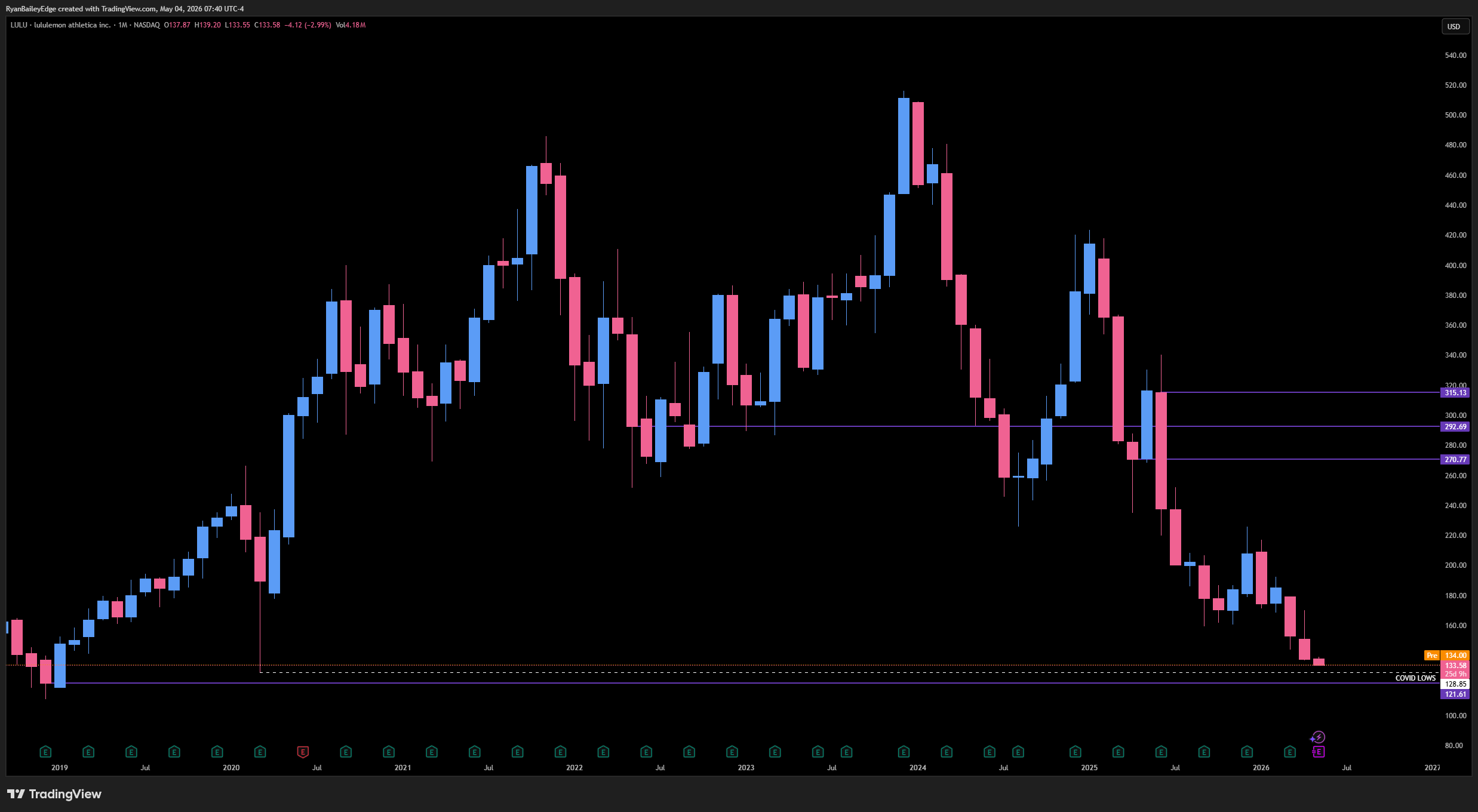
The stock closed Friday at $133.58. That’s down roughly 60% from the 52-week high of $335.19 set in June 2025, and over 74% off the all-time high of $516.39 from December 2023. Wall Street has been dumping it. FinTwit has written its obituary. Most of what’s being said about why this stock is broken is flat-out wrong.
Here’s the deal: Lululemon is not collapsing because of a debt bomb, a failed acquisition, or some structural rot in the business model. It’s being repriced from “elite premium compounder” to “brand and execution turnaround.” That’s a very different conversation. And if price does what I’m watching for at the COVID lows, this could be the cleanest multi-generational long setup in retail I’ve seen in a long time.
Let me break it all down — what’s actually wrong, what isn’t, and the exact trade I’m stalking

What FinTwit Is Wrong About
Before we get to the real problems, let’s clear out the noise. There are four narratives floating around that simply don’t hold up to the filings.
Narrative 1: “They’re drowning in debt.” False. LULU ended fiscal 2025 with $1.807 billion in cash and another $593.6 million available on its revolving credit facility. There are no traditional borrowings outstanding beyond $6.4 million in letters of credit. Total funded debt is effectively zero. The “debt” you see on screening sites is operating lease liabilities — $298.7M current and $1.50B non-current — which is just the future rent on its store base. That’s a real cost, but it’s not leverage in the financial-distress sense.
Narrative 2: “They’ve blown shareholder capital on bad acquisitions.” Mostly false. The Mirror disaster was real — LULU paid roughly $500 million for the at-home fitness company in 2020 and eventually wrote almost all of it off, taking another $98.2 million in pre-tax charges in 2023 to wind it down. That was a black eye on capital allocation. But it’s already in the rearview, and the only meaningful acquisition since was a $176.1 million tuck-in to bring its Mexico operations in-house in 2024 — too small to move the needle.
Narrative 3: “Brick-and-mortar is killing them.” Half-true, but not the way most people think. LULU still operates 811 company-owned stores and brick-and-mortar revenue actually grew slightly in fiscal 2025, from $5.01B to $5.05B. The problem isn’t the channel — it’s productivity. Sales per square foot fell from $1,574 in 2024 to $1,426 in 2025 — a 9.4% decline in a single year. That’s the brand-equity tell. Stores aren’t bleeding money, but the box is producing less per square foot than it used to, and that’s where the operating leverage starts to bite.
Narrative 4: “The CEO is arrogantly raising prices, Apple-style, to prove the brand is superior.” This one I want to address directly because I’ve heard it from multiple readers, and it’s nonsense. There is no credible source supporting it. What management has actually said is the opposite — they’re taking modest, selective price increases on a small portion of the assortment, item-by-item, specifically as tariff pass-through, not brand-proofing. The strategy in 2026 is to reduce markdowns and return to full-price selling — not to raise the sticker price across the board to make a statement. Also worth noting: Calvin McDonald, the CEO that comment was attributed to, stepped down in January 2026. He’s gone. Heidi O’Neill, formerly of Nike, was named the new CEO but doesn’t even start until September 8, 2026. In the meantime, Meghan Frank (CFO) and André Maestrini are running the company as interim co-CEOs.
So if you’ve been told this stock is broken because of debt, M&A disasters, store closures, or arrogant pricing — you’ve been told the wrong story.
What’s Actually Killing the Stock
The real story is simpler and more dangerous: the U.S. consumer has cooled on Lululemon at the same time tariffs are eating margins. That’s it. That’s the whole bear case.
Start with the Americas. The region accounted for roughly 71% of fiscal 2025 revenue, and it just went negative. Americas revenue declined 1% on the year. Comparable sales fell 3%. Q4 was worse — Americas revenue down 4% and comps down 1%. U.S. revenue specifically slipped from $6.48 billion in 2024 to $6.33 billion in 2025. Management is now guiding Americas comp declines of 1% to 3% in 2026. That’s the company telling you, in writing, that its biggest market is going to shrink again this year.
Now layer on tariffs. Lululemon sources heavily from Vietnam and China, and the 2025 tariff regime — combined with the removal of the de-minimis exemption that previously allowed under-$800 e-commerce shipments duty-free — hammered the cost structure. The company says the tariff and de-minimis hit reduced 2025 gross profit by approximately $275 million. For 2026, the gross tariff impact is projected to climb to $380 million, with management targeting roughly $160 million in mitigation. Net hit: around $220 million.
You can see the damage in the margin line. Q4 2025 gross margin collapsed 550 basis points to 54.9%, with about 520 bps of that coming directly from tariffs. Full-year gross margin was down 260 bps to 56.6%. Operating margin fell 380 bps to 19.9%. Diluted Q4 EPS dropped from $6.14 to $5.01.
Then there’s the inventory problem. Year-end inventory hit $1.7 billion, up 18% year-over-year, while units were only up 6% and revenue grew 5%. When dollar inventory growth materially outpaces sales growth, you’re either eating tariff-inflated cost-per-unit or staring at future markdowns. Probably both.
And finally, competition. Alo Yoga and Vuori have been quietly eating Lululemon’s lunch — particularly with younger and affluent customers. Vuori operates 93 U.S. stores with an average ticket of about $185 versus LULU’s $145. Alo runs 99 U.S. stores and saw peak periods in 2024 with up to 88% year-over-year sales growth. Both have deliberately been opening locations within half a mile of Lululemon stores. Among ultra-wealthy households, Vuori has captured 15.6% market share in some categories — that’s exactly LULU’s old core demographic. Lululemon’s own 10-K admits its fabrics and manufacturing technology generally aren’t patented and can be imitated by competitors at lower price points. That’s the dupe risk in plain English.
The Bull Case: A Brand Multiple Reset, Not a Broken Business
Here’s why I find this setup so interesting: none of the above is permanent damage. This is a company that still generated $11.1 billion of revenue, $1.58 billion of net income, and approximately $922 million of free cash flow in fiscal 2025. The balance sheet is a fortress. There’s no funded debt, $1.8 billion in cash, and a clean revolver.
International is genuinely working. China Mainland revenue grew 28.9% in fiscal 2025 with a 40% segment operating margin. Rest of World grew 15.6% with 23% segment margins. The company is entering six new international markets in 2026 — its largest single-year expansion ever, including Greece, Austria, Poland, Hungary, Romania, and India.
Valuation is at a decade-low. At $133.58, LULU trades at roughly 10x trailing earnings and about 11x the midpoint of FY2026 EPS guidance ($12.10–$12.30). For most of the last ten years, this stock traded between 25x and 40x earnings. Even if you assume earnings stay flat from here, the multiple compression alone is historic.
Management is buying. The company repurchased $1.178 billion of stock in fiscal 2025 and has roughly $1.6 billion still authorized after the board approved a $1 billion increase last December. Insiders have been buying alongside the buyback — Director Chip Bergh’s trust purchased nearly $1 million of shares in March, and interim co-CEO André Maestrini added almost $500K at $151. That’s not noise. That’s conviction near 52-week lows.
And finally, the Heidi O’Neill catalyst. Whether the market liked the pick or not, a new CEO with a clear mandate to restore product heat is, on its face, a positive optionality event. If she lands the strategic reset and the Americas business stabilizes, this stock doesn’t need a heroic re-rating to move sharply higher.

The Bear Case: Cheap Can Get Cheaper
Now the honest counterpoint, because anyone selling this as a no-brainer is doing you a disservice.
The most dangerous version of the bear case is this: the Americas weakness is not cyclical. It’s structural. Customers may have moved on. If Alo, Vuori, Nike’s Skims partnership, and the wave of Amazon and Costco dupes have permanently captured the price-conscious half of LULU’s old customer base, then no amount of “product newness” fixes it. Selective price increases backfire spectacularly when brand heat is gone.
If that’s the world we’re in, fiscal 2026 EPS guidance of $12.10–$12.30 isn’t a trough — it’s a way station on the path to $8–$10. At those numbers, today’s stock isn’t washed out at all. A 12x multiple on $9 in earnings puts you at $108. Not coincidentally close to my invalidation level, which we’ll get to.
Tariffs may also be more structural than transitional. The company itself flagged in its 10-K that tariff and de-minimis changes are expected to keep pressuring product costs, gross profit, and operating income. Even if some duties get rolled back via the courts (LULU has filed for refunds), the supply-chain repositioning to non-Asia geographies takes years.
Two more things worth flagging. First, buybacks exceeded free cash flow in fiscal 2025: $1.178 billion repurchased against approximately $922 million in FCF. That’s not a crisis when you have $1.8B in cash, but it does mean the buyback engine that’s been supporting EPS is running ahead of organic cash generation. Second, fiscal 2026 capex guidance is $725 million to $745 million, above 2025 levels. So even if earnings stabilize, FCF could stay pressured.
There’s also a securities class action covering the December 2023 to July 2024 period alleging false and misleading statements related to inventory and product offerings, plus related derivative actions. Not the main reason for the stock’s decline, but it adds to the governance cloud.
The Technical Setup: Why $121.61 Is the Line
This is where the chart starts telling a story the fundamentals can’t.
The COVID swing low sits at $128.85. That level was forged in the panic of March 2020 — one of the most brutal liquidity events in modern market history. When the entire S&P 500 reset, LULU bottomed there, and that low has held for over six years.
Below it, at $121.61, sits the last untested monthly level going all the way back to 2019, before the COVID era even began. That’s a level the market has not revisited in roughly seven years. When price approaches a structural reference point that old and that clean, you’re no longer trading earnings revisions. You’re trading market memory.
A move into $121.61 would do two things at once. It would sweep the COVID swing low — taking out resting liquidity below $128.85 and trapping every short and stop-loss seller stacked under that level — and it would tag the pre-COVID monthly. That’s the kind of liquidity event that often produces a multi-generational reversal, because every long-term holder, every value buyer, and every algorithmic accumulator has the same level marked.
If price gets there, holds, reacts, and then reclaims the COVID low on a daily close basis, that’s the signal.
My Trade Plan
This is the part that matters. We are not catching a falling knife.
Step 1: Wait for the sweep. I want to see price decline into $121.61 — taking out the COVID low at $128.85 along the way. That sweep is the trap, not the trade.
Step 2: Demand a reaction. Price needs to hold $121.61 and show real buying response. A wick-and-bounce is a start. A stabilization day is better. What I don’t want is a clean break-and-go through this level.
Step 3: Wait for the reclaim. This is the confirmation. I want a daily close back above the COVID low at $128.85 — once at minimum, ideally twice — to confirm that the sweep was rejected and the COVID low has been officially reclaimed. That close-above is what turns this from a falling knife into a structural long.
Step 4: Initiate the long. Once the reclaim is confirmed on the daily, I’m taking a major position.
Near-term targets:
T1: $155.49 — first major upside reference
T2: $189.00 — extended target into the broader 2025 range
Higher time frame swing targets:
T3: $292.50
T4: $316.00
These last two are not next-week or next-month targets. These are swing objectives that may take a year or longer to play out. But here’s the logic: if price plays this level cleanly and progresses through T1 and T2, the structural case for a return to the broader 2024–2025 range opens up. A reclaim of a multi-generational low isn’t a small event. When these levels resolve correctly, they tend to produce moves that eclipse what most traders are willing to hold for. If the brand reset under Heidi O’Neill takes hold, international keeps compounding, and the Americas business stabilizes — even modestly — these are reasonable destinations on a 12-to-18-month horizon.
I’m not married to those numbers. I’m scaling out at T1 and T2 like any disciplined trader. But if the setup confirms and the fundamentals start to follow, I’ll be holding a runner all the way up.
Invalidation: $109.50. If price closes below this level on the daily, the entire setup is dead. Move on.
The math here is favorable. From a confirmation entry around $130, T1 at $155.49 is roughly +20%, T2 at $189 is +45%, T3 at $292.50 is +125%, and T4 at $316 is +143%. Invalidation at $109.50 is roughly -16%. That’s a clean asymmetric setup with real long-tail upside if the turnaround takes hold.
Bottom Line
Lululemon is not a debt-driven collapse. It’s a premium brand multiple reset against the backdrop of weakening Americas demand and an ugly tariff cycle. The bull case is that the brand still has real pricing power, international is compounding, the balance sheet is bulletproof, and the stock is the cheapest it’s been on earnings in over a decade. The bear case is that the Americas customer has structurally moved on, and “cheap” earnings get cheaper if EPS keeps sliding.
This is exactly the kind of setup where structure beats opinion. I don’t need to predict whether the bull or bear case wins on a five-year horizon. I need to react to what price does at the most important level on the chart.
If LULU sweeps $121.61, holds, and reclaims the COVID low at $128.85 with a daily close — I’m a buyer, with conviction, targeting $155.49 and then $189. If it breaks $109.50 and stays there, I’m out.
That’s how you trade a generational level without bleeding capital trying to be a hero. Let the level prove itself. Let the chart confirm. Then commit.
I’ll be watching $121.61 every day until this resolves.
Until next time—trade smart, stay prepared, and together we will conquer these markets!
Ryan Bailey, VICI Trading Solutions.